Notice: register_sidebar_widget is deprecated since version 2.8.0! Use wp_register_sidebar_widget() instead. in /home/q85ho9gucyka/public_html/wp-includes/functions.php on line 3931
Calvin and Calvinism » 2007 » August

Archive for August, 2007

31
Aug

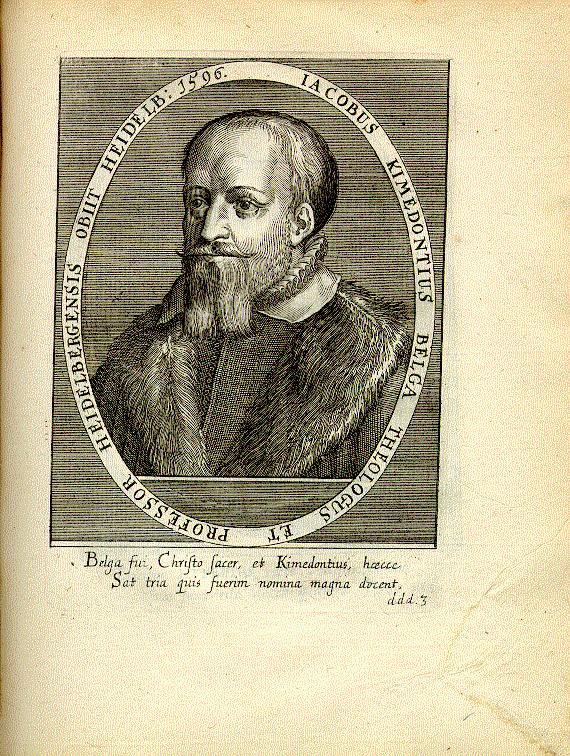
A nice picture of Jacob Kimedoncius

   Posted by: CalvinandCalvinism    in Uncategorized

Jacob Kimedoncius

31
Aug

Robert Dabney on 1 Tim 2:4-6

   Posted by: CalvinandCalvinism    in 1 Timothy 2:4-6

Dabney on allusions or references to 1 Tim 2:4-6:

1) These passages doubtless teach that the Son was, in the beginning, the immediate agent of creation for these, as for all other beings; and that the God-man now includes angels in His mediatorial kingdom, in the same sense in which He includes the rest of the universe, besides the saints. But that He is not a mediator for angels is clear, from the fact that, while He is never called such, He is so emphatically called “the Mediator between God and man” (1 Tim. 2:5). Second. He has assumed no community of nature with angels. Last. It is expressly denied in Hebrews 2:16, 17. (Greek.) Lectures, p., 232.

2) In conclusion, the powerful demonstration which the Scripture gives us against creature worship is the strongest proof against creature mediation; for if they mediated, they must be worshiped.

The Scripture testimony must hold the fifth, and crowning place. We have heard the Apostle assert, (1 Tim. 2:5) that as there is one God, there is one Mediator, between God and men, and that this is the Being who gave himself a ransom for all. As the words, “one God,” doubtless express the exclusive unity of God, so we are bound to construe the counterpart words, “one Mediator,” in the same way. And it is implied that He who mediates must have given the adequate ransom, on which to found His plea. So, our Savior declares, (John 14:6) “No man cometh to the Father but by me,” and Peter, (Acts 4:12) “There is none other name under heaven, given among men, whereby ye must be saved.” So, the words of Christ, (John 6:37) “Him that cometh to me, I will in no wise cast out,” at least prove that any other intercessor is superfluous. It is said, that affirmations do not prove the counterpart negative. But when we find the Scriptures full of such passages as Rom. 8:34; 1 John 2:1, 2, which all assert with emphasis that the Lord Jesus Christ is our Mediator, and that there is an absolute silence throughout the Bible as to any other, even this proof is complete. Lectures, p., 482.

3) The attempt is made to escape the force of the places which assert the oneness of Christ’s intercession, by saying that He is the only Mediator of Redemption; saints and angels are Mediators of Intercession. On this subterfuge I remark. (a) 1 Tim. 2:5, asserts the singleness of Christ’s intercessory work first, and at least as pointedly as of His ransoming work. (b) Since intercession is grounded only in redemption by satisfaction, the two kinds of mediators must be one. (c) Roman Catholics themselves undermine their own distinction by impiously ascribing to their creature intercessors an imputable merit as the necessary ground of their influence with Christ. Lectures, pp., 482-483.

4) Christ Our Ransom. Again, He is said in many places to be our Redeemer—i. e., Ransomer—and His death or He, is our Ransom, Matt. 20:28; 1 Pet. 1:19; 1 Tim. 2:6; 1 Cor. 6:20. It is vain to reply that God is said to redeem His people in many places, when the only meaning is, that He delivered them, and that Moses is called the redeemer of Israel out of Egypt, who certainly did not do this by a vicarious penalty. Christ’s death is a proper ransom, because the very price is mentioned. Lectures, 511.

5) From Texts Teaching A Seeming Universality. The other class of objections is from the Scriptures; e. g., Those which speak of Christ as having compassion for, or dying for, “the whole world,” “all,” “all men,” “every man,” John 1:29; John 3:16; 4:42; 6:51; 2 Cor. 5:19; 1 John 1; John 12:32; 1 Cor. 15:22; 2 Cor. 5:14, 15; 1 Tim. 2:6; 1 Tim. 4:10; Heb. 2:9. The usual explanation, offered by the strict Calvinists, of these texts is this: that terms seemingly universal often have to be limited to a universality within certain bounds by the context, as in Matt. 3:5; that in New Testament times, especially when the gospel was receiving its grand extension from one little nation to all nations, it is reasonable to expect that strong affirmatives would be used as to its extent, which yet should be strained to mean nothing more than this, that persons of every nation in the world were given to Christ. Hence, “the world,” “all the world,” should be taken to mean no more than people of every nation in the world, without distinction. There is a certain amount of justice in these views, and many of these passages, as 1 Cor. 15:22; John 1:29, and 12:32, may be adequately explained by them. The explanation is also greatly strengthened by this fact too little pressed by Calvinists, that ultimately, the vast majority of the whole mass of humanity, including all generations, will be actually redeemed by Christ. There is to be a time, blessed be God, when literally all the then world will be saved by Christ, when the world will be finally, completely, and wholly lifted by Christ out of the gulf, and sink no more. So that there is a sense, most legitimate, in which Christ is the prospective Savior of the world. Lectures, p., 524-525.

6) To Express His Benevolence. God’s second design in making the common call universal was the exercise of the general holiness goodness, and compassion of His nature, (which generally regard all His creatures), in dissuading all from sin and self destruction. God’s holiness, which is universally opposed to sin, makes it proper that He shall dissuade from sin, every where, and in all sinners. God’s mercy and goodness, being made possible towards the human race by their being under a gospel dispensation, make it proper that He shall dissuade all from self destruction. And this benevolence not only offers a benefit to sinners generally, but actually confers one—i. e., a temporary enjoyment of a dispensation of mercy, and a suspension of wrath, with all the accompanying mercies, and the offer itself of salvation. This offer is itself a benefit, only man’s perverseness turns it into a curse. Blessed be God, His word assures us that this common call is an expression of sincere benevolence towards all sinners, elect and non-elect, (a compassion whose efficient outgoing is, however, conditioned, as to all, on faith and penitence in them). Ezek. 33:11; Ps. 81:13; 1 Tim. 2:4. Lectures p., 555.

Dabney:

In proof of the general correctness of this theory of the extent of the Atonement, we should attach but partial force to some of the arguments advanced by Symington and others, or even by Turrettin, e.g., That Christ says, He died “for His sheep,” for “His Church,” for “His friends,” is not of itself conclusive. The proof of a proposition does not disprove its converse. All the force which we could properly attach to this class of passages is the probability arising from the frequent and emphatic repetition of this affirmative statement as to a definite object.

Dabney, Lectures, p., 521.

31
Aug

Charles Hodge on 1 John 2:2

   Posted by: CalvinandCalvinism    in 1 John 2:2

Hodge:

This is what is meant when it is said, or implied in Scripture, that Christ gave Himself as a propitiation, not for our sins only, but for the sins of the whole world. He was a propitiation effectually for the sins of his people, and sufficiently for the sins of the whole world. Augustinians have no need to wrest the Scriptures. They are under no necessity of departing from their fundamental principle that it is the duty of the theologian to subordinate his theories to the Bible, and teach not what seems to him to be true or reasonable, but simply what the Bible teaches.

Charles Hodge, Systematic Theology, 2:558-9.

31
Aug

Shedd on 1 John 2:2

   Posted by: CalvinandCalvinism    in 1 John 2:2

1) “The human conscience is the mirror and index of the divine attribute of justice.  The two are correlated.  What therefore God’s justice demands, man’s conscience demands.  ‘Nothing,’ says Matthew Henry, ‘can pacify an offended conscience but that which satisfied an offended God.’  The peace which the believer in Christ’s atonement enjoys, and which is promised by the Redeemer to the believer, is the subjective experience in man that corresponds to the objective reconciliation in God.  The pacification of the human conscience is the consequence of the satisfaction of divine justice.  God’s justice is completely satisfied for the sin of man by the death of Christ.  This is an accomplished fact: ‘Jesus Christ the righteous is the propitiation for the sins of the whole world.’ (1 John 2:2). The instant any individual man of this world of mankind believes that divine justice is thus satisfied, his conscience is at rest.  The belief is not needed in order to establish the fact.  Whether a sinner believes Christ died for sin or not will make no difference with the fact, though it will make a vast difference with him: ‘If we believe not, yet he abides faithful: he cannot deny himself’ (2 Tim. 2:13).  Unbelief cannot destroy a fact.  Should not a soul henceforth believe on the Son of God, it would nevertheless be a fact that he died an atoning death on Calvary and that this death is an ample oblation for the sin of the world.  But it must be remembered that the kind of belief by which a man obtains a personal benefit from the fact of Christ’s death is experimental, not historical or hearsay. And a sinful man may have no skeptical doubt that the death of Christ on Mount Calvary has completely expiated human guilt and may even construct a strong argument in proof of the fact and still have all the miserable experience of an unforgiving sinner, may still have remorse and the fear of death and the damnation of hell. Whenever there is an experimental belief of the actual and accomplished fact of Christ’s atonement, there is a subjective pacification of the conscience corresponding to the objective reconciliation of divine justice.  But this subjective effect of Christ’s death is neither the primary nor the whole effect of it.  It presupposes the objective satisfaction or propitiation. In this instance, as in all others, the object is prior to the subject and determines its consciousness.” Shedd, Dogmatic Theology, 2:409-11.

2) In the third place, an atonement, either personal or vicarious, when made, naturally and necessarily cancels legal claims. This means that there is such a natural and necessary correlation between vicarious atonement and justice, that the former supplies all that is required by the latter. It does not mean that Christ’s vicarious atonement naturally and necessarily saves every man; because the relation of Christ’s atonement to divine justice is one thing, but the relation of a particular person to Christ’s atonement is a very different thing. Christ’s death as related to the claims of the law upon all mankind, cancels those claims wholly. It is an infinite “propitiation for the sins of the whole world,” 1 John 2:2. But the relation of an impenitent person to this atonement, is that of unbelief and rejection of it. Consequently, what the atonement has effected objectively in reference to the attribute of divine justice, is not effected subjectively in the conscience of the individual. There is an infinite satisfaction that naturally and necessarily cancels legal claims, but unbelief derives no benefit from the fact…

This reasoning applies to vicarious atonement equally with personal. Justice does not require a second sacrifice from Christ, in addition to the first. “Christ was once offered to bear the sins of many,” Hebrews 10:28 [sic]. This one offering expiated “the sins of the whole world,” and justice is completely satisfied in reference to them. The death of the God-man naturally and necessarily cancelled all legal claims. When a particular person trusts in this infinite atonement, and it is imputed to him by God, it then becomes his atonement for judicial purposes as really as if he had made it himself, and then it naturally and necessarily cancels his personal guilt, and he has the testimony that it does in his peace of conscience. Shedd, Dogmatic Theology, 2:437, 438.

3) The Christian gospel–the universal offer of pardon through the self-sacrifice of one of the divine persons–should silence every objection to the doctrine of endless punishment.  For as the case now stands, there is no necessity, so far as the action of God is concerned, that a single human being should ever be the subject of future punishment

“For the Scriptures everywhere describe God as naturally and spontaneously merciful and declare that all the legal obstacles to the exercise of this great attribute have been removed by the death of the Son of God ‘for the sins of the whole world‘ (1 John 2:2).  In the very centre of the holy revelations of Sinai, Jehovah proclaimed it to be his inherent and intrinsic disposition to be ‘merciful and gracious, long-suffering, forgiving iniquity and transgression’ (Exod. 34:6-7). Shedd, Dogmatic Theology 2:749

4) But, secondly, there are degrees of mercy. Because God does not show the degree of it to a particular sinner, it does not follow that he does not show him any at all. He may grant him the mercy of common grace, and which this is resisted and nullified by his hostile self-will arid obstinate love of sin, he may decide not to bestow the mercy of special grace, and yet not be chargeable with destitution of love and compassion towards him.1 Any degree of love is love; and any degree of compassion is compassion. To contend that the Divine love must be of exactly the same degree towards all creatures alike or else it is not love, is untenable. It is certain that God can feel love and pity towards the souls of all men, as his creatures and as sinners lost by their own fault, and manifest it in that measure of grace which “leads to repentance” (Rom. 2:4), and would result in it if it were not resisted, and yet not actually save them all from the consequences of their own action. This Scriptures plainly teach that God so loved the whole world that he gave his only-begotten Son to make expiation for “the sins of the whole world;” and they just as plainly teach that a part of this world of mankind are sentenced, by God, to eternal death for their sins. The Arminian and the Calvinist both alike deny the doctrine of universal salvation, yet believe that this is compatible with the doctrine of God’s universal benevolence. Both deny the inference that if God does not save every human being, he does not love the soul of every human being; that if lie does not do as much for one person as he does for another, he is merciful towards him. It is a fallacy to maintain, that, unless God does all that is possibly can to save a sinner, he does not do anything towards his salvation; as it would be fallacious to maintain, that unless God bestows upon a person all the temporal blessings that are within his power, he does not show him any benevolence at all. This fallacy lies under the argument against preterition. It is asserted that if God “passes by” a sinner in the bestowment of regenerating grace, he has no love for his soul, no desire for its salvation, and does nothing towards its welfare.

Footnote 1: Man is compelled to speak of God’s decision or decree in this way, though strictly there is no before or after for him. All his decrees are eternal and simultaneous. Yet there is an order of nature. Special grace supposes the failure of common grace.

William G.T. Shedd, Calvinism Pure and Mixed (New York: Charles Scribner’s Sons, 1893), 45-46.